TCM
Thank you for your huge work since 1.0 !! Question about TCM. How does it works ? It is general (independant from brands). You tall it. But on "size" spreadsheet, whatever TCM strenght, the CTDIvol is practically the sam
Thank you for your huge work since 1.0 !!
Question about TCM. How does it works ? It is general (independant from brands). You tall it. But on "size" spreadsheet, whatever TCM strenght, the CTDIvol is practically the same. But on "Mother", it decreases when the strenght grows. Is it because there is no Height/weight adjustment on "Mother" ?
No batch available yet with gestational age. Is it WIP ? Height/weight adjustment too ? It would be very useful...
Thank you
NCI Dose Team response
When you use TCM strength greater than zero, CTDIvol is averaged from slice-specific CTDIvol (weighted by modulated mA) and displayed on the GUI for all phantom libraries including ICRP, size, and mother. Can you make sure you’re using the latest version 3.0.20211123?
Community reply
I am on 3.0.20211123.
Now it works fine and i did not reproduced this malfonction. I do not understand ...
Community reply
Can you tell me wich size is used for the mother, please ? Around 170 cm and 55 kg i guess ?
Are you working on body size change for pregnant women ?
NCI Dose Team response
The mother phantom was designed using the reference adult female phantom at 163 cm and 60 kg (NCICT interface shows 164 cm though). We do not have a plan to create body size-dependent mother phantoms but do you think it's worth it?
Community reply
Thank you for the size.
Up to me, it's worth it !
Estimate foetus dose is, for me, the only emergency for a medical physicist working in radiology.
After a car accident, as an exemple, a pregnant women can have one (or more) CT-scan (and radiology, interventionnal radiology ...) and the MP needs to estimates the foetus dose in order to compare to ICRP84 to know if there are malformation risk or mental retardation (above 100 mGy). In France in anyway.
So, it's worth it to be able to modulate according to mother's size (in addition of children's age). It would be awesome ! I do not think that any software does this...
As an exemple, with CT-expo you can only estimate the uterus dose of a non-pregnant women !
NCI Dose Team response
We understand the needs. Assuming you're okay we copy and paste your comments to the feature requests. We think it is feasible to add more phantoms with various weights to the reference size mother phantoms. Thanks!
Community reply
the output of Absorbed dose differs sufficiently depending on the level of TCM (if chosen).
Does this mean that the TCM level must be set obligatory on dose calculation? or when we use custom CTDIvol derived from the Dose report (GE BrightSpeed), this value has already accounted according to the TCM level which was set during the CT examination, so we don't need to specify the TCM in the program window?
NCI Dose Team response
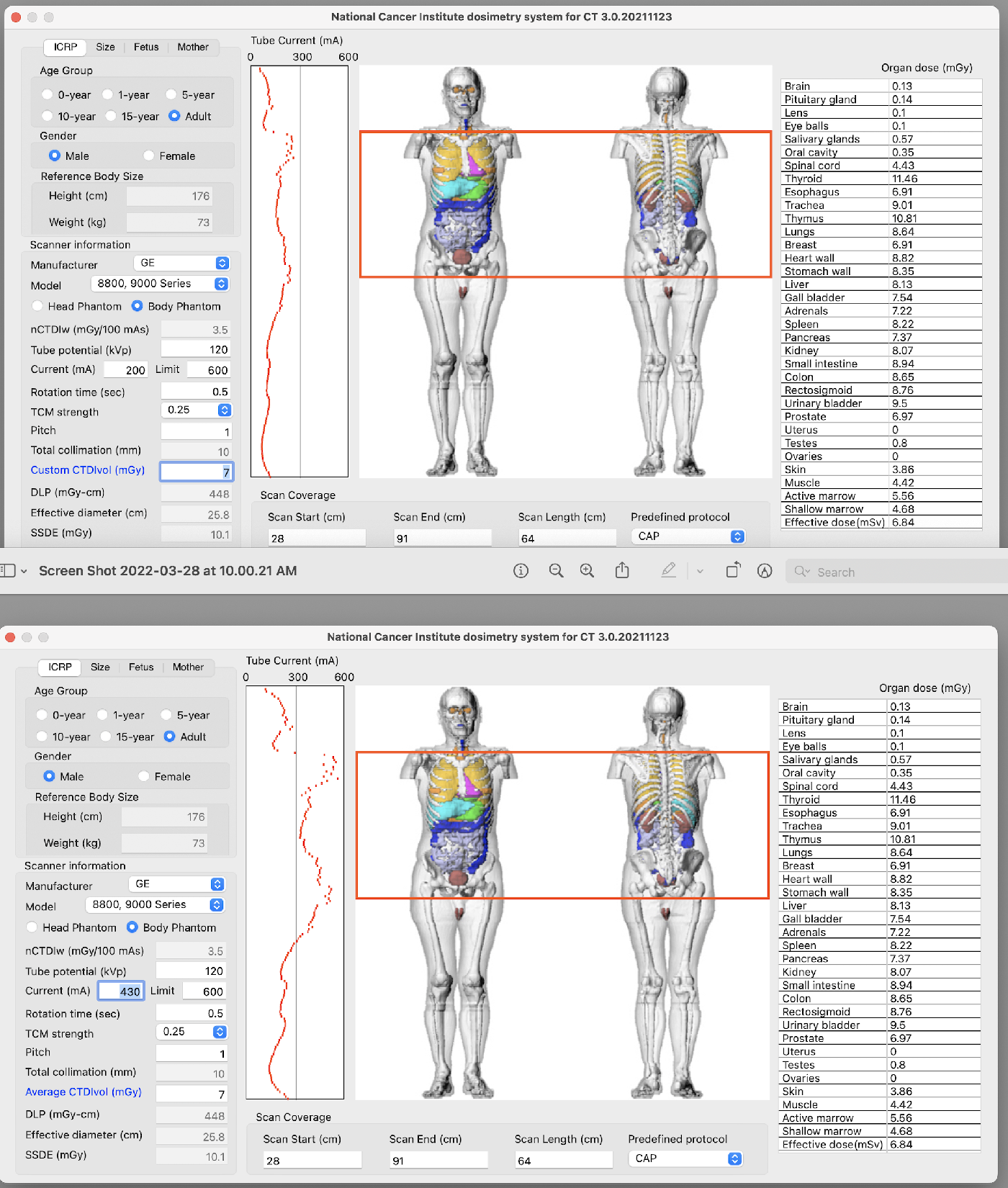
Sorry for the delayed response. The custom CTDIvol is expected to be the average of modulated CTDIvol across the scan range, which can be obtained from the dose report. That means when you used TCM in your scan, the modulation is already reflected in the custom CTDIvol. However, you still need to set TCM strength to account for longitudinal modulation. Otherwise, the fixed average CTDIvol will be used for all slices. We attached two examples: custom CTDIvol of 7 mGy with 0.25 TCM strength vs. custom current 430 mA with TCM strength 0.25 (resulting in CTDIvol of 7 mGy). Both calculations will give you the lung dose 8.64 mGy. Hope this helps.
Community reply
Dear the NCI Dose Team, thank you - this is helpful.
From your answer I conclude, that (in disregard to TCM modulation is already reflected in the custom CTDIvol) the TCM strength must be specified along with the custom CTDIvol when using NCICT.
Back to my previous question, when GE scanner is used, how (where) can I find the TCM strength level for dose calculation?
If I correct, the example attached demonstrate that the TCM is on. So we just need to understand, what TCM level to choose.
I think that is important because the output will vary greatly depending on TCM set:
Custom CTDIvol 39.82 from our example at 120 Kv and TCM strength=0.0 gives us brain dose of 19.41 mGy,
whereas the TCM strength=1.0 with the same custom CTDIvol 39.82 gives us brain dose equal to 1.3 mGy
NCI Dose Team response
Since the TCM algorithm is generic and not vendor-specific, the TCM strength must be calibrated by users through comparing the TCM curves with the ones obtained from scanners. TCM strength is a general term and different vendors have their own terms equivalent to the concept. We are currently working with several clinical collaborators to create a guideline for different vendors which we hope may achieve reasonable accuracy.
Community reply
Thank you for the answer.
Summarizing, when GE scanner with active auto-TCM is used, but the proper TCM strength level is unknown, the TCM strength level cannot be ignored and must be set. In general approximation (as for me), it is appropriate to use TCM strength 0.5 instead of 1.0 value. But if we want to be more precise, the question is in
comparing the TCM curves with the ones obtained from scanners.
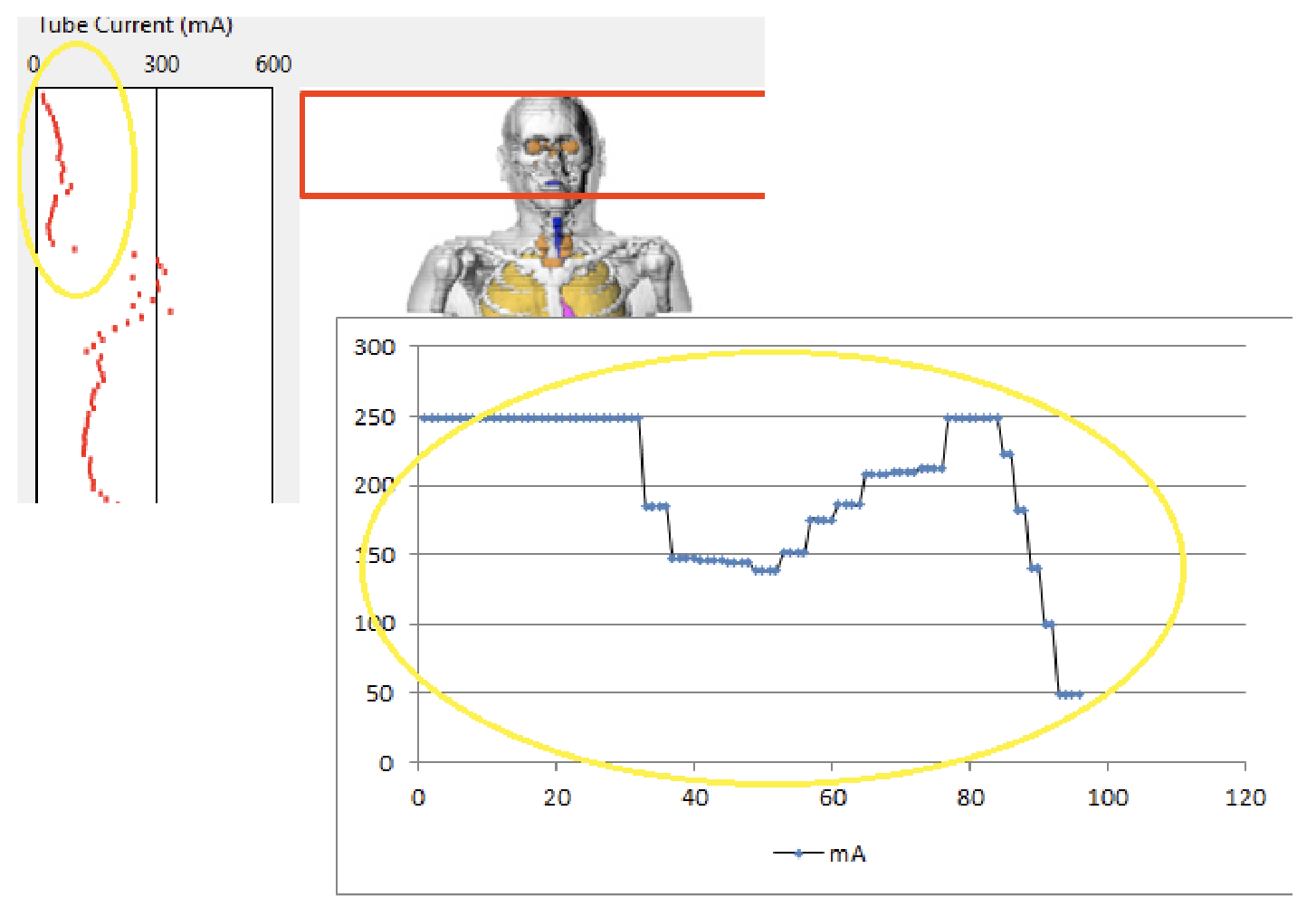
Please, explain more detailed how can it be compared? As on the picture in the previous post, we have a set of TC parameters per each slice. so we can draw a curve of modulated TC for each scan. Which TCM curves should we take to perform the comparison?
NCI Dose Team response
From your dose page and mA plot, we can guess this was a head scan with the scan range of about 20 cm (first scan) and 10 cm (second scan). The mA curve looks like from the second 10 cm scan if the unit of the x axis is in mm. We would create this kind of mA curves for CAP scan and compare them with the one generated from NCICT while you adjust TCM strength (equivalent parameters on your scanner and the TCM strength in NCICT). This way, you may find the set of parameters from your scanner as well as in NCICT showing the best agreement. Since NCICT does not export the mA modulation curve, you will need to visually compare the two curves.
Community reply
Dear the NCI Dose Team, thank you - my example is indeed the head examination within the two subsequent series of scans, both around 10 cm, so the total scan length is around 20. This mA curve is for the second series (just illustrative).
Do you mean we should compare NCICT TCM and this mA curves (see attached)? Beacause I have no idea how to do that without the parameters realized in the NCICT to create a graph.
Again, why do we need CAP, when the TCM realized in the NCICT is applicable for head exam? In the paper you attached in the previuos discussion (Li, 2015) the TCM is only used for trunc examinations. If so, back to my first question, should we set TCM to 0.0 when head examination is processed, ignoring that mA has been automatically changed during the series (assuming that the CTDIvol derived from the DoseReport has been averaged for whole series of scans during head examination, and it has been already calculated accounting different mA per each slice?)
I apologize for this persistent question, but this is really matters because the output brain dose varies greatly depending on real CTDIvol and the TCM strength.
NCI Dose Team response
We tried to answer your questions below in bold.
Do you mean we should compare NCICT TCM and this mA curves (see attached)? Beacause I have no idea how to do that without the parameters realized in the NCICT to create a graph.
As we mentioned in the previous post, NCICT does not give you numeric TCM profiles so that you can only visually compare the curve with yours... Let us add an export button next to the mA for users to export the values for comparison.
Again, why do we need CAP, when the TCM realized in the NCICT is applicable for head exam?
We didn't mean you comparing the TCM values for CAP scans with your TCM values for head scan. You have to obviously compare the values for the same scan coverage.
In the paper you attached in the previuos discussion (Li, 2015) the TCM is only used for trunc examinations. If so, back to my first question, should we set TCM to 0.0 when head examination is processed, ignoring that mA has been automatically changed during the series (assuming that the CTDIvol derived from the DoseReport has been averaged for whole series of scans during head examination, and it has been already calculated accounting different mA per each slice?)
We realized that the TCM profiles created for trunk region based on Li et al. 2015 does not work well for the head region as well as for pediatric patients. We are working on another TCM profile library for the adult head scan and pediatric patients.
I apologize for this persistent question, but this is really matters because the output brain dose varies greatly depending on real CTDIvol and the TCM strength.
No problem! These are all important questions and we appreciate your feedback
Community reply
Dear the NCI Dose Team, thank you for the detailed answer, this is much clear now. I think this is a great idea to add an export button next to the mA for users to export the values for comparison. In addition to this user self calibration (USC) function, this TCM feature can be realized in the following way:
-
User must specify if the scan series were performed using fixed TC (yes/no), or the CareDose, ASIR or another modulation system was active. In case of using fixed Current the "Limit" box should reflect the "Current", and the TCM strength box is unavailable.
-
If TC modulation is active, it must be specified the level of strength, if known.
So the list of values of the variable TCM strength should start with "Unknown"-"0.25"-"0.5"-"0.75"-"1.0"-"User defined". But in case of USC mode, this parameter should have separate "Custom" box for non-discrete values.
- If the strength level is unknown, the averaged TCM strength may be set by default as an averaged characteristic of all the scanners of given type, so in this case "Unknown" <=>" Averaged"
As for me, the TCM strength picture has little information, so may be this is make a sense to move it from the main window to another tab, along with the USC parameters.
Hope you find this helpful.
NCI Dose Team response
Since each vendor implements TCM differently, is a mostly proprietary technology and varies by body region and application/protocol, it makes the most sense to be able to upload TCM profiles to NCICT in the future for dose reconstructions.
It is very unlikely that the strength of TCM adaption is known, and at least at our institution, the vast majority of the protocols retain the default "average" adaptation. This information is not contained in the DICOM image metadata and only available at the CT console.
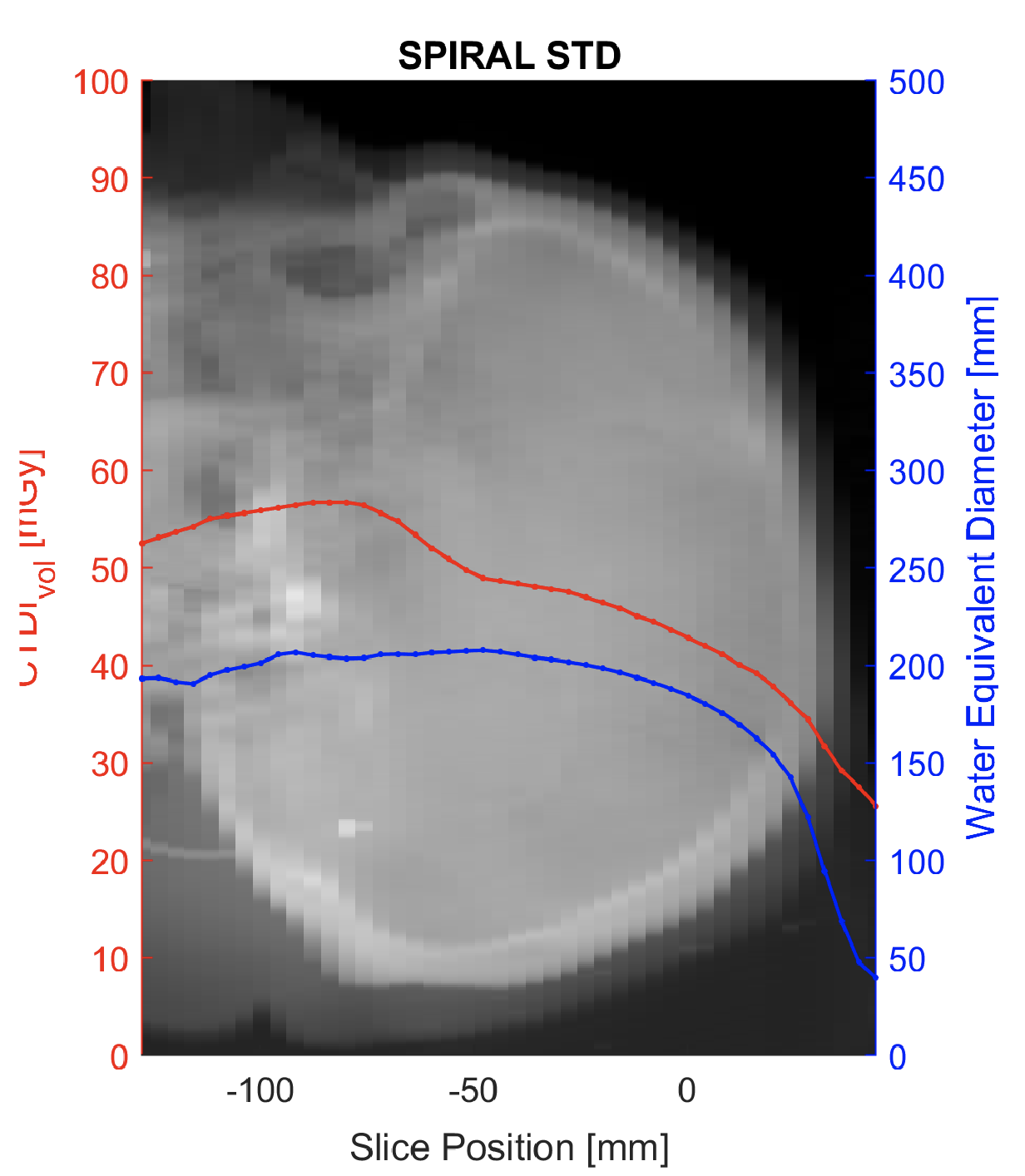
For now, we believe the best dose estimates for head scans in NCICT should be using a fixed mA/CTDI(vol) using the value reported on the CT dose report. The TCM algorithm in NCICT currently underestimates dose for head scans. This is also seen in pediatric scans, which the NCI Dose Team mentioned. We believe it is because it is still using a 32 cm CTDI phantom for reference attenuation. In reality, there is not significant mA modulation in head scans (see attached) and the brain dose shouldn't change much from a fixed technique. Some newer scanners perform organ-based modulation and perform angular modulation to reduce lens dose, but in NCICT we are just considering z-axis modulation. the NCI Dose Team, correct us if we are wrong. Thanks.
-Seth
NCI Dose Team response
Hi Seth, thanks for the comments. We agree with the fixed mA for head scans. We're adding the TCM import feature to the future feature request section.